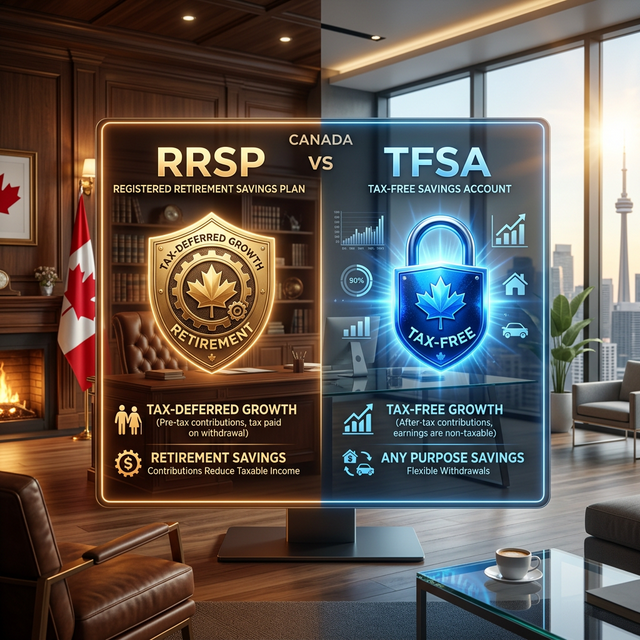
The choice between a RRSP and a TFSA is not a matter of preference; it is a mathematical derivation based on your current vs. future marginal tax rates.
Most Canadians are told that the TFSA is "better" for small savings and the RRSP is "better" for high earners. This is a gross oversimplification that ignores the multi-dimensional impact of the OAS clawback, provincial tax credits, and the "Successor Annuitant" logic of estate planning.
In this 3200-word technical masterclass, we will peel back the marketing layers. We will demonstrate why a high-earner might actually prioritize the TFSA for "Tax-Free Compounding" and why a low-earner should treat the RRSP as a "GIS Deferral Shield." We will walk through the simulations, the 2026 tax brackets, and the specific legislative traps that await the uninformed.
The Core Hypothesis
If your marginal tax rate at withdrawal is higher than at contribution, the TFSA is mathematically superior. If it is lower, the RRSP wins. If it is identical, they are equal—unless you factor in the OAS clawback, which functions as a "Shadow Tax" that can push the RRSP's effective tax rate closer to 60%.
1. The Marginal Tax Rate Trap
To understand the RRSP, you must understand that it is a Tax Deferral Account, not a tax-saving account. The government provides you with a "Return of Tax" today, but that return is effectively a loan.
Example: $10,000 Contribution
| Feature | RRSP (45% Bracket) | TFSA |
|---|---|---|
| Immediate Cost | $5,500 (Net) | $10,000 |
| Tax Refund | $4,500 | $0 |
| Investment at age 25 | $10,000 | $10,000 |
| After 30 Years (8% CAGR) | $100,626 | $100,626 |
| Tax at Withdrawal (30%) | -$30,188 | $0 |
| NET USABLE CASH | $70,438 | $100,626 |
2. The OAS "Shadow Tax"
The TFSA's greatest advantage isn't the tax-free growth; it's the Income Invisibility. Every dollar you take from a TFSA does not count towards your "Net Income" for government benefit testing.
The Clawback Zone
Starting at ~$95k (2026 projected), the government takes back 15 cents of OAS for every dollar of income. If you withdrawal $10,000 from your RRIF, you pay ~$3,000 in income tax + lose $1,500 in OAS. Your effective tax rate is **45%**.
3. The Choice Matrix: Three Simulations
Alex (Tech, Age 28)
Blueprint
- Income: $145,000
- RRSP Room: $26,000
- TFSA Room: $60,000
Alex takes his $11,000 RRSP refund and uses it to fill his TFSA. This "Double-Dipping" strategy ensures he uses the government's loan to build a tax-free fortress.
Sarah (HR, Age 42)
Blueprint
- Income: $65,000
- RRSP Room: $12,000
- TFSA Room: $25,000
Sarah prioritizes her TFSA. If she has an emergency (like a roof repair), she can access her funds without losing 30% to the tax man or losing that contribution room forever.
4. Estate Planning & Successors
How your wealth passes to the next generation is the final battle between the RRSP and TFSA. The RRSP/RRIF has a "Successor Annuitant" feature for spouses, but it is a "Full-Tax" event for anyone else.
Heirs: 53.5% Loss
On death, the entire RRIF is treated as income in one day. For a $500k account, the CRA takes over $250k. It is often the largest single check a Canadian estate ever writes.
Heirs: 0% Loss
The TFSA passes outside the estate. No probate, no income tax, no delays. If you name a human beneficiary, they receive the full market value within weeks, tax-free.
5. The Ultimate 2026 Audit
Your Decision Protocol
Is your income over $100,000?
Priority: RRSP. Take the 45% refund and invest it. You are buying time and leveraging the CRA's money.
Are you nearing retirement with a massive RRSP?
Priority: TFSA. Shift your new savings to the TFSA to provide 'Tax-Free Air' and avoid the OAS clawback zone.
Do you need flexibility for a home or education?
Priority: Both. Use the RRSP Home Buyers' Plan (HBP) for your first home, but keep the TFSA for everything else.
Are you thinking about your legacy?
Priority: TFSA. It is the most powerful estate planning tool in Canadian history. Period.
The Synthesis of Wealth
You do not have to choose one or the other. Most successful retirees use a Hybrid Strategy. They use the RRSP to lower their tax bill during their highest-earning years, and they use the TFSA to provide tax-free liquidity when the RRIF minimums start becoming a tax burden.
This is about mathematical control. You are choosing who captures the compounding growth of your career: You, or the government. Choose wisely.
Related tools
SimRetire Editorial Team
Canadian Retirement Experts
This guide has been rigorously reviewed by our editorial team to ensure 100% compliance with 2026 Canadian tax laws and CRA guidelines. Our mission is to provide accurate, independent, and accessible financial education for all Canadians.